The Seasonal Shield Tonic
A deeply concentrated, elderberry syrup-style decoction for the season when everyone around you is coughing. Simmered with warming roots and raw honey, it is a fiercely protective shield against the winter wind.

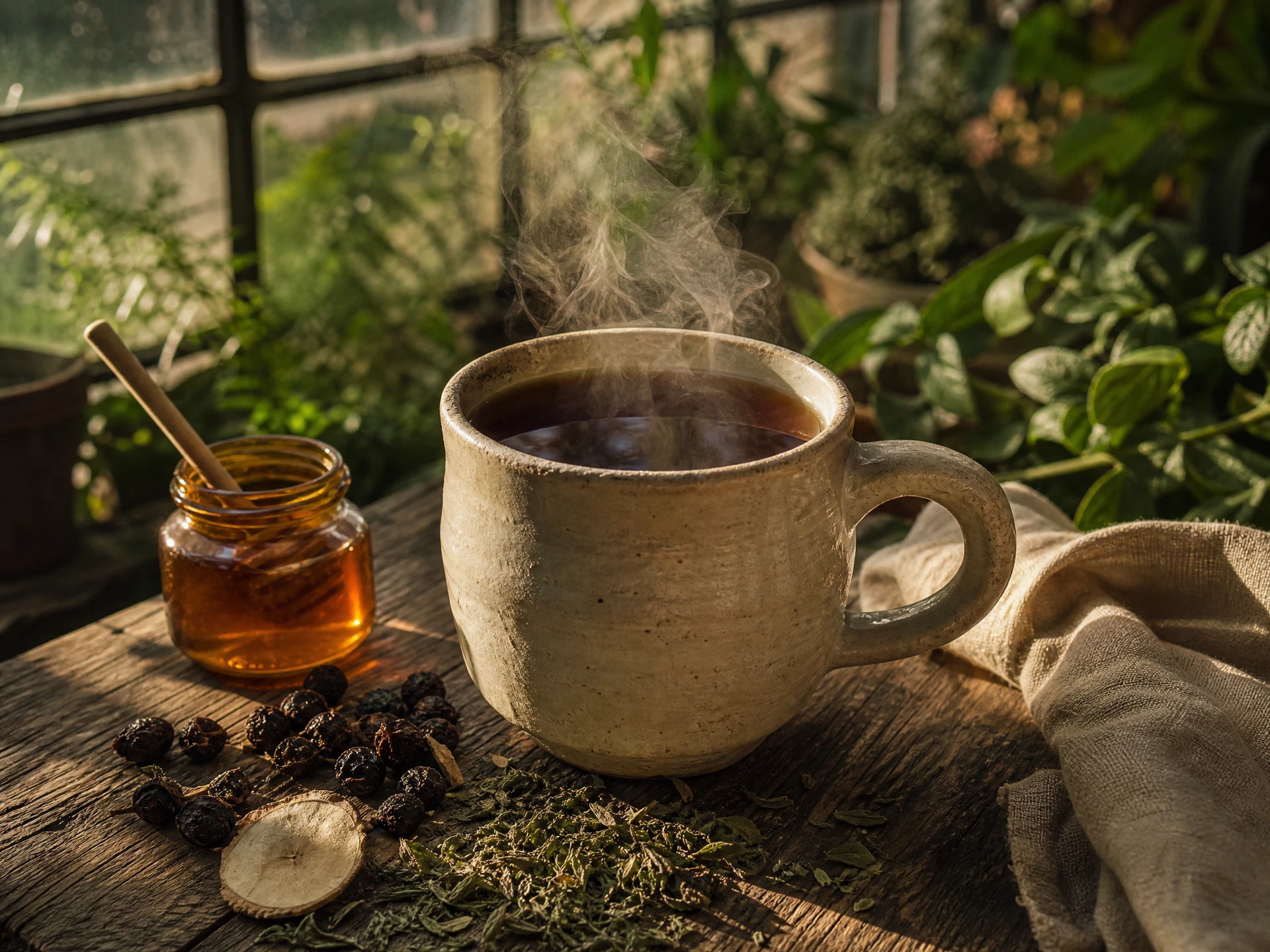
There is a specific quality to the air in late January—a thin, brittle cold that seems to carry every cough and sniffle from the school drop-off line straight into your kitchen. You know the season. It is the time of year when the open-plan office sounds like a ward, when the person in the middle seat on your flight is nursing a fever, and when you can feel the collective exhaustion of winter settling into your bones. The days are short, and the demands on your time do not pause just because the earth has gone dormant. This is not the moment for a delicate floral tea. This is the moment for a shield.
For generations, women have stood at their stoves as the days grew short, simmering dark berries and warming roots into something thick, sweet, and fiercely protective. The Seasonal Shield Tonic is our answer to the season of depletion. It is a deeply concentrated, elderberry syrup-style decoction that calls on the earth’s most resilient botanicals to stand between you and the winter wind. When you are running on empty, when your reserves are low, and when you need to give your body what it has been asking for, this is what we reach for. It is a reminder that you do not have to push through the winter unprotected.
Making this tonic is an act of claiming space for your own resilience. The house will fill with the scent of ginger and clove, a spiced warmth that feels like a heavy quilt settling over your shoulders. It is a reminder that the earth already made the medicine; we just have to remember how to prepare it. By taking the time to simmer the roots and berries, you are participating in a tradition as old as winter itself, building a foundation of vitality that carries you through the darkest months. Tending the pot, watching the water turn the color of midnight, is a grounding practice in a season that often feels unmoored.
Before we begin, there is a fundamental rule of the apothecary to understand: the difference between an infusion and a decoction. When we work with delicate leaves and flowers, we steep them in hot water. But roots, barks, and dried berries are stubborn. They hold their medicine deep inside, and they require time and heat to surrender it. This tonic is a decoction. You cannot rush it. The elderberries and echinacea must be simmered, not steeped, to draw out their deep purple strength. And when it comes to the raw honey, patience is just as vital. Honey is a living thing, full of enzymes that are destroyed by boiling heat. You must wait until the dark liquid has cooled to the temperature of a warm bath before stirring in the sweetness.
The Ritual
This is not a tonic you drink by the mugful. It is concentrated, potent, and meant to be taken with intention. Think of it as a daily ritual during the weeks when you feel most vulnerable to the season. A tablespoon taken straight from the jar each morning before you step out into the cold is often enough. It coats the throat, warms the chest, and leaves a lingering spice that reminds you of your own strength. It is a small, deliberate act of self-preservation before the demands of the day begin.
When you feel the first undeniable scratch at the back of your throat, or when you have spent the day in a room where the air feels heavy and compromised, you might take a spoonful every few hours. It is a short-course botanical, meant for the moments when you need it most, rather than a continuous daily habit year-round. Echinacea, in particular, is a plant that works best when called upon for a specific task, rather than leaned on indefinitely. It is the guard at the gate, not the foundation of the house.
If the straight syrup feels too intense, you can stir a spoonful into a cup of hot water with a squeeze of fresh lemon, creating an instant, deeply comforting tea. It is beautiful stirred into morning oats, or even taken alongside a warming cup of something like our Spiced Ginger Brew when the chill has truly set in. For those days when you need to support your immunity and your energy simultaneously, this tonic is the foundation you build upon. It is a versatile preparation, ready to meet you wherever you are in your day.
Making It Yours
The beauty of a decoction is its resilience; it can handle your adaptations. If you cannot find dried echinacea root, the leaf will do, though the root offers a deeper, more grounding energy. The fresh ginger is non-negotiable for its sharp, clearing heat, but the spices can shift according to what you have in your pantry. A star anise pod adds a beautiful, licorice-sweet complexity, while a few cardamom pods can lift the heavy berry notes into something brighter. You might even add a strip of dried orange peel if you crave a touch of citrus oil in the background.
If you are making this for a household, you can easily double the recipe. Just ensure your pot is large enough that the liquid does not boil over, as elderberry stains are notoriously stubborn. The finished tonic will keep in the refrigerator for several weeks, a dark glass jar of readiness waiting on the shelf. It is a comfort just knowing it is there, tucked behind the milk, ready for the morning you wake up feeling less than yourself.
When adjusting the sweetness, remember that the raw honey is not just for flavor; it acts as a preservative and a soothing agent for tired throats. If you prefer a less sweet tonic, you can reduce the honey slightly, but know that it will not keep quite as long. Always taste the decoction before adding the honey—it should be earthy, tart, and intensely spiced. The honey brings it into balance, transforming a strong herbal brew into something that feels like a comfort.
If you find yourself drawn to this kind of preparation, you might also explore our Deep Winter Roots blend, which follows a similar decoction method but focuses entirely on building deep, sustained energy. The apothecary is yours to explore, one simmering pot at a time. The plants are here, waiting to be remembered, ready to offer their strength when yours is running low.
Best for
The recipe
The Seasonal Shield Tonic
What you'll need
1/2 cup Dried elderberries
Must be cooked, never raw
1/4 cup Dried echinacea root or leaf
Root preferred for deeper energy
2 inches Fresh ginger
Sliced into thin rounds
1 Cinnamon stick
Broken in half
1 teaspoon Whole cloves
4 cups Filtered water
1/2 cup Raw honey
Local if possible
1/2 Fresh lemon
Juiced
How to make it
- 1
Combine the dried elderberries, echinacea, fresh ginger slices, cinnamon stick, and cloves in a medium saucepan.
- 2
Pour in the filtered water and bring the mixture to a rolling boil over medium-high heat.
- 3
Once boiling, immediately reduce the heat to a low simmer and partially cover the pot.
- 4
Let the roots and berries simmer gently for 30 to 40 minutes, until the liquid has reduced by about half and turned a deep, midnight purple.
- 5
Remove the pot from the heat and let it cool until it is safe to handle, but still quite warm.
- 6
Strain the dark liquid through a fine mesh sieve into a glass jar, pressing the back of a spoon against the berries to extract every last drop of medicine.
- 7
Wait until the liquid has cooled to the temperature of a warm bath—this is crucial so you do not destroy the living enzymes in the honey.
- 8
Stir in the raw honey and fresh lemon juice until the honey is completely dissolved.
- 9
Seal the jar and store it in the refrigerator, where it will keep for several weeks.
The reasoning
Why This Works
Elderberries have been valued for centuries as a foundational botanical for the winter months. Traditional practice holds that these dark, tart berries support the body's natural defenses, offering a deep well of resilience when the season turns cold. They are the anchor of this tonic, providing both the rich, dark base and the protective qualities that herbalists have long reached for when the community is feeling depleted.
Echinacea is perhaps the most famous of the protective botanicals, but it is often misunderstood. In folk practice, it is not a daily tonic but a specific, targeted herb meant to be called upon when you feel your reserves being tested. It works in tandem with the elderberry, acting as the immediate guard at the gate while the berries provide sustained support.
The warming spices—ginger, cinnamon, and clove—do more than just flavor the decoction. They are traditionally understood to stimulate circulation and bring heat to the body, helping to clear stagnation and move the heavier energy of winter. Finally, the raw honey acts as a soothing agent for tired throats and a natural preservative, binding the sharp, earthy flavors into a preparation that feels like a comfort.
Before You Brew This
Elderberries must always be cooked; never eat raw or unripe elderberries, or their stems and leaves, as they can cause severe stomach upset. Because echinacea is traditionally used to stimulate the body's defenses, it should be avoided by those with autoimmune conditions or anyone taking immunosuppressant medications. If you have a known allergy to plants in the daisy family, such as ragweed, you may also react to echinacea. This tonic is designed as a short-course botanical for when you need it most, rather than a continuous daily habit. Finally, remember that raw honey should never be given to infants under one year of age. If you are navigating a complex health season, please bring this recipe to your own practitioner to ensure it is the right fit for you.
Want more like this?
Pull up a chair.
Start with our free guide, 7 Tonics Every Woman Should Know, then a letter each week — recipes, plant wisdom, and what we're brewing as the season turns.
Coming, eventually
The Seasonal Shield Tonic, pre-blended
One day this will come measured out in a tin, from us. It doesn't yet. Tell us where to write when it does.