warming
Dong Quai
Angelica sinensis
Known in traditional Chinese medicine as the ultimate root for women's vitality, dong quai is a warming, grounding herb used to build reserves and encourage a smooth, regular cycle. Often called "female ginseng," it is best used not alone, but woven into thoughtful formulas to deeply nourish the body.
Traditionally reached for
Where it comes from
Folklore & History
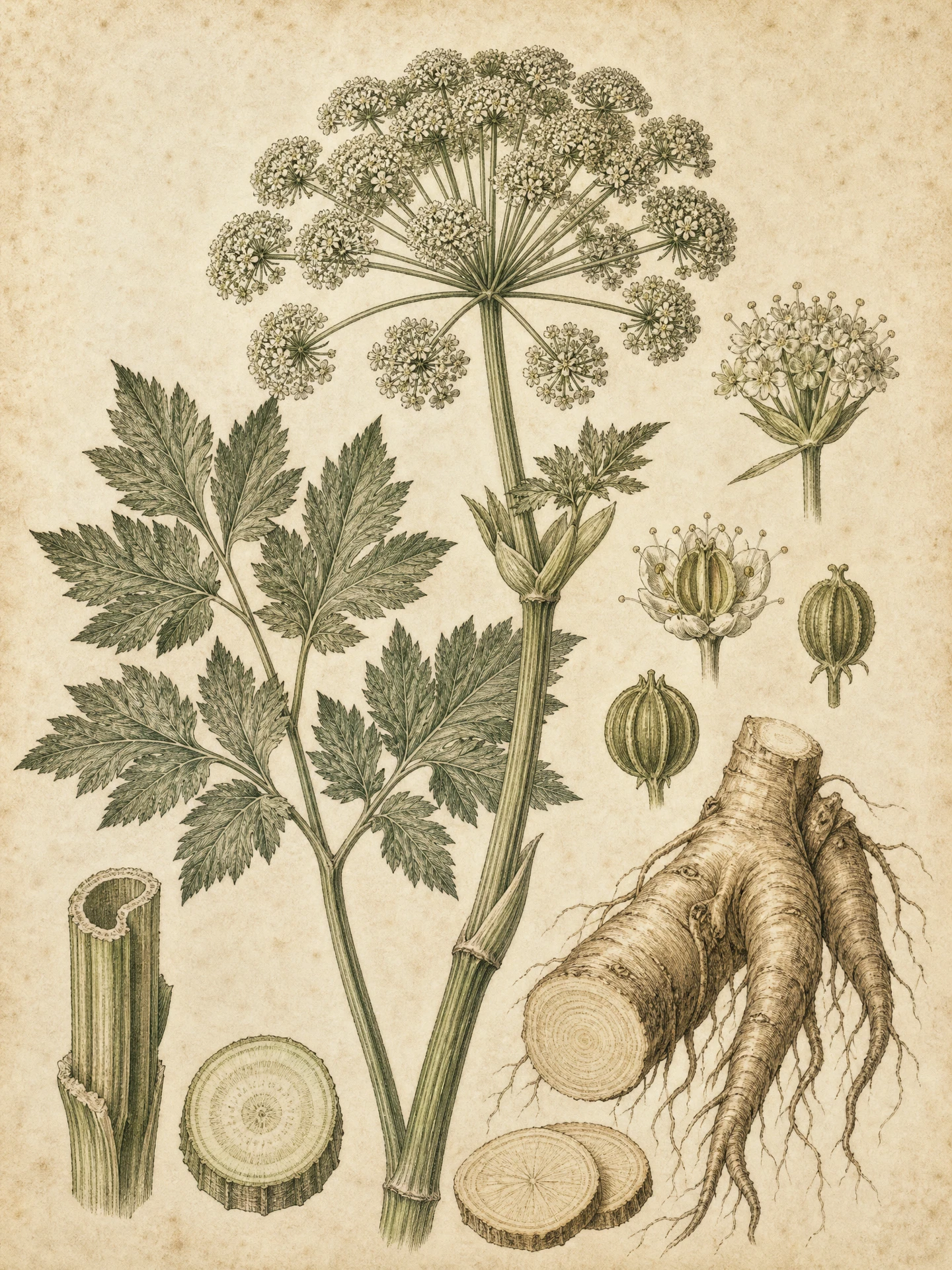
If you were to walk into a traditional apothecary and ask for the root that sustains women, you would be handed a bundle of Angelica sinensis. Known as dang gui in Traditional Chinese Medicine, this member of the celery family grows in the cool, damp, high-altitude mountains of China, Japan, and Korea. When you slice into the thick, yellow-brown root, it releases a scent that is entirely its own—a sweet, musky, slightly bitter aroma that smells unmistakably like deep earth and old medicine.
For thousands of years, dang gui has been revered as the ultimate botanical ally for women. Its name loosely translates to "state of return," a poetic nod to its traditional use in helping the body return to its natural rhythm and vitality. In the ancient texts, it is the premier herb for nourishing what Chinese medicine calls "Blood." But Blood in this tradition means something far more expansive than the red fluid in our veins. It is the cooling, moistening, anchoring substance of the body—the deep well of reserves that gives us our capacity to rest, to menstruate smoothly, and to feel grounded in our own skin. When that well runs dry, we feel brittle, anxious, and depleted.
What makes dang gui so fascinating is that it is almost never used alone in its native tradition. It is a consummate team player, designed to be woven into complex formulas where its warming, moving nature is balanced by other herbs. The most famous of these is Si Wu Tang, or Four-Substance Decoction, a foundational recipe that has been simmered in clay pots for centuries to replenish women after childbirth or a heavy bleed. It is the botanical equivalent of a deeply nourishing stew made by someone who loves you.
In the West, it is often called "female ginseng," a nickname that attempts to capture its importance but misses its nuance. Where ginseng is fiery and pushing, dang gui is warming and building. It does not force energy; it restores the foundation from which energy naturally arises. For women seeking cycle support, it has long been the root we reach for when the body feels cold, stagnant, or simply drained of its vital reserves. It is a reminder that true vitality does not come from stimulation, but from deep, quiet nourishment.
In plain language
What It Actually Does
When herbalists talk about dong quai, we are usually talking about movement and nourishment. In traditional practice, this root is understood to do two things beautifully: it builds the blood, and it moves the blood. It is the herb we reach for when a woman's cycle feels stuck, scanty, or accompanied by the kind of cold, cramping ache that makes you want to curl around a hot water bottle.
The tradition holds that dong quai brings warmth and circulation to the pelvis. By encouraging healthy blood flow to the reproductive organs, it is traditionally used to support a smooth, regular menstrual cycle and ease the transition through hormone balance shifts. It is often paired with herbs like red raspberry leaf to tone the uterus, or vitex to encourage a steady rhythm.
But here is the honest truth about dong quai: the "female ginseng" nickname oversells it, and the modern Western habit of taking it solo in a capsule fundamentally misunderstands how it was designed to be used. This is not a magic pill that fixes your hormones overnight. Because it is a warming, moving herb, taking it alone can sometimes be too stimulating or ungrounding for certain constitutions. It is a plant that demands context.
Furthermore, because its primary traditional action is to move blood, it can increase menstrual flow. If your periods are already heavy, or if you are prone to flooding, dong quai is likely not the right herb for you—it will simply encourage more of what you are already experiencing. It is best suited for those whose cycles are late, light, or accompanied by a feeling of coldness and stagnation.
This is also an herb where working with a trained practitioner of Traditional Chinese Medicine genuinely changes the outcome. A skilled herbalist will know exactly how to blend it with cooling or astringent herbs to match your specific body. When used correctly, as part of a thoughtful formula, it is profoundly restorative. When used haphazardly, it can miss the mark entirely. It is a potent reminder that in herbalism, as in life, the way we use a thing matters just as much as the thing itself.
How to use it
Preparation
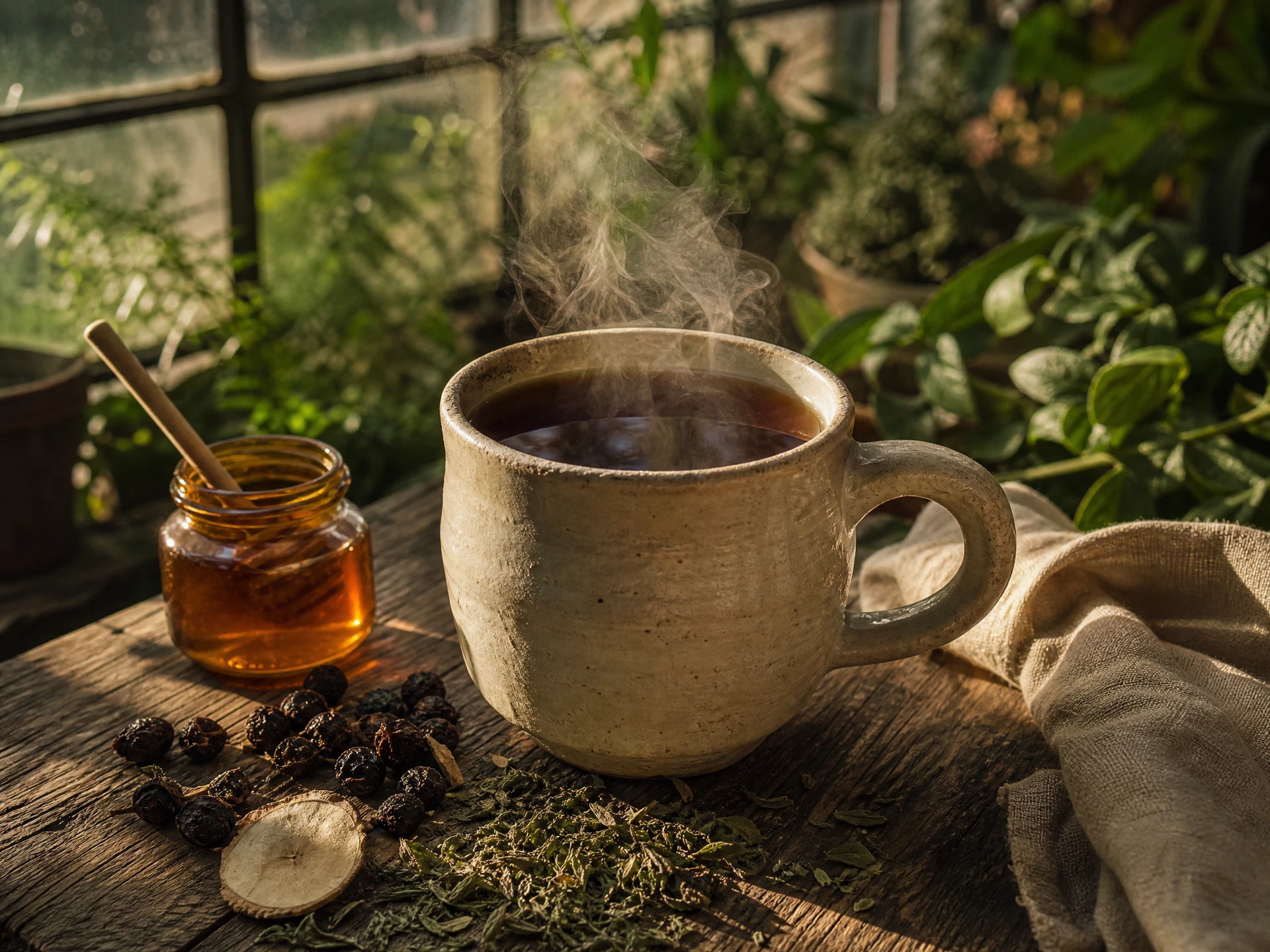
Because dong quai is a dense, woody root, it will not yield its medicine to a quick steep in hot water. It requires a decoction—a slow, rolling simmer that coaxes the active compounds out of the tough plant material. To prepare it traditionally, you would simmer about a teaspoon of the dried, sliced root in two cups of water for twenty to thirty minutes, until the liquid is reduced by half and takes on a rich, earthy color.
However, because of its strong, musky-celery flavor, many women find a straight decoction difficult to drink. This is why it is so often incorporated into broths and soups in Chinese cooking, where its savory notes blend beautifully with root vegetables and bone broth. If you prefer to take it as a tea, it is best blended into a larger formula, such as a moon cycle tonic, where ginger, cinnamon, or licorice can balance its robust taste.
Tinctures are another excellent and practical way to bring dong quai into your routine. A standard traditional amount is often a dropperful taken two to three times a day, though this varies depending on the formula. Powders and capsules are widely available, but they bypass the sensory experience of the herb—the smell and taste that begin the digestive and energetic work before the plant even reaches your stomach.
Timing matters with this root. Traditional practice suggests taking it in the weeks leading up to your period to build reserves and encourage a smooth flow, but pausing it during the actual days of heavy bleeding, as its blood-moving properties can increase your flow.
When buying dong quai, look for dried root slices that are pliable, slightly oily, and deeply aromatic. If the root is brittle, dusty, or lacks that signature sweet-musky scent, it has lost its vitality. Store it in a cool, dark place in an airtight glass jar, where it will keep its potency for about a year. As a tonic herb, it works slowly; you would typically look for subtle shifts in your energy and cycle over two to three months of consistent, thoughtful use.
Who Should Be Careful
Pregnancy & Nursing
The tradition is clear: avoid dong quai entirely during pregnancy and nursing, as its strong downward, blood-moving energy is not suited for this time.
Dong quai is a powerful mover of blood, and that strength means we must treat it with deep respect. Because it encourages circulation and flow, you should absolutely avoid it if you experience heavy menstrual bleeding or have a diagnosed bleeding disorder. For the same reason, it must not be taken alongside blood thinners, including warfarin and aspirin, and you should stop using it well before any upcoming surgery.
The tradition is very clear that this is not an herb for pregnancy or nursing. Its downward, moving energy is exactly what we do not want when the body is holding and nourishing a new life. Additionally, because it has an affinity for the reproductive system, those with hormone-sensitive conditions should step away from this root. Finally, dong quai contains compounds called furocoumarins, which can make your skin more sensitive to the sun—so if you are taking it, be mindful of your time in direct sunlight.
We want you to feel safe and supported as you explore these old traditions, so please bring this information to your own healthcare practitioner to make sure it is the right fit for your body.