tonic
Vitex (Chaste Tree Berry)
Vitex agnus-castus
A slow, profound berry that works quietly on the pituitary gland to support the delicate dance of estrogen and progesterone. Herbalists have long reached for the chaste tree to encourage regular cycles, soothe premenstrual tension, and prepare the body for conception.
Traditionally reached for
Where it comes from
Folklore & History
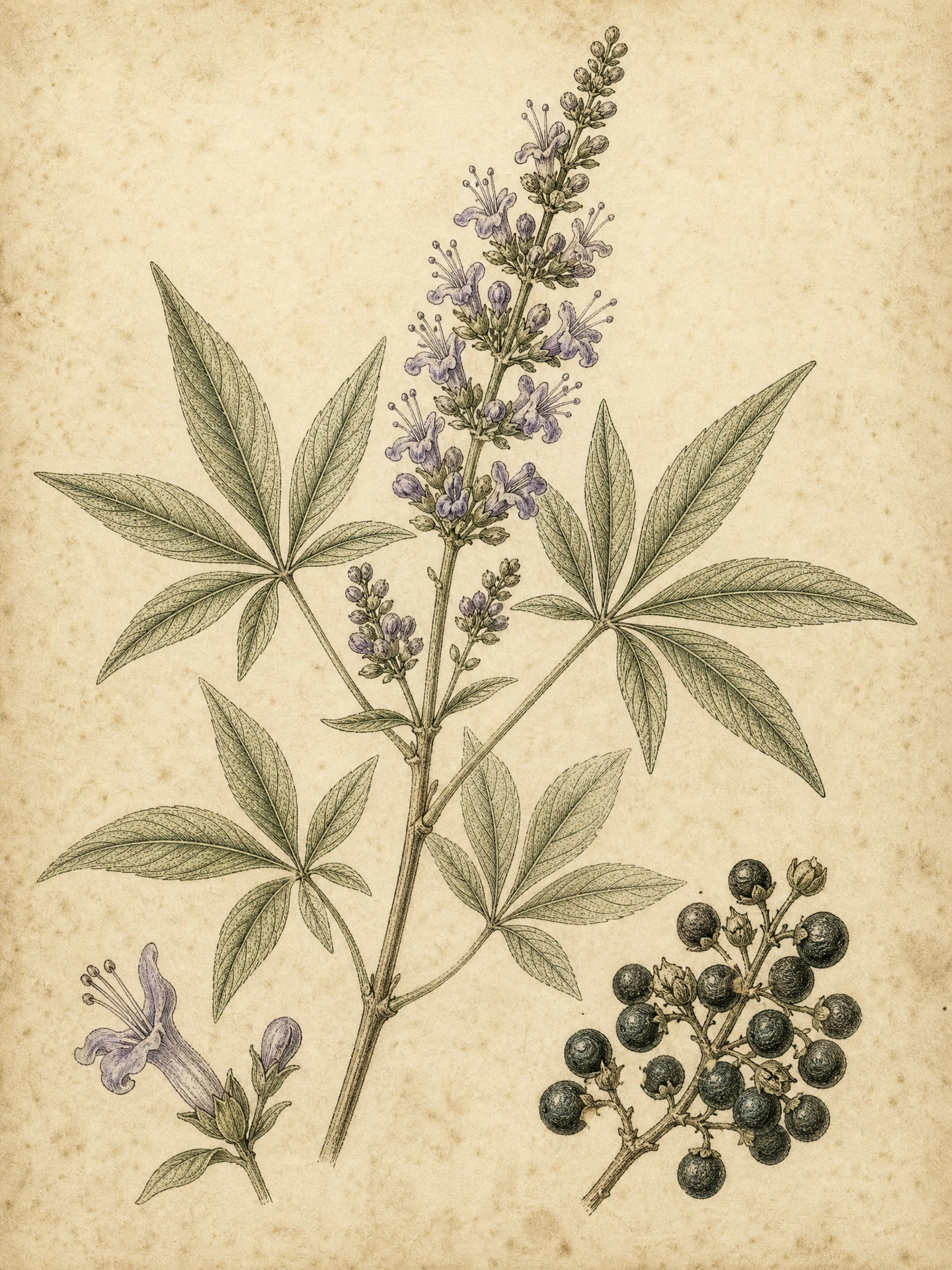
If you were to walk along a sun-baked riverbank in the Mediterranean, you might brush past a sprawling, aromatic shrub with slender, silvery-green leaves and spikes of pale violet flowers. This is Vitex agnus-castus, the chaste tree. By late summer, those delicate blooms give way to small, dark, peppercorn-like berries. Crush one between your fingers, and the scent is sharp, peppery, and deeply resinous—a fragrance that hints at the profound, slow-moving medicine held within.
The history of vitex is a fascinating tapestry of contradictions. In the ancient world, it was woven into the fabric of women's medicine. The Greeks called it lygos, and women participating in the sacred rites of Demeter would weave its branches into their bedding, believing it cooled the fires of passion and kept them pure during the festival. Centuries later, medieval monks in Europe chewed the pungent berries for the exact same reason—to suppress their libido and maintain their vows of celibacy. This practice earned the plant its enduring folk names: monk's pepper and chaste tree.
Yet, while the monks were using it to quiet their desires, village herbalists and midwives were quietly gathering those same dark berries to support the rhythms of the female body. They understood that vitex was not simply a dampener of vitality, but a profound regulator. It was the herb they reached for when a woman's cycle was erratic, when her bleeding was heavy, or when she was struggling to conceive. It was a plant of the threshold, helping women transition through the shifting tides of their reproductive years.
What makes vitex so unique in the apothecary is its pace. In a world that demands immediate results, the chaste tree asks for your patience. It is a slow, deliberate herb. It does not force the body into submission; rather, it works quietly on the pituitary gland, the master conductor of your endocrine system. Like turning a massive ship, the effects of vitex unfold over months, not days. It is a reminder that true hormone balance is a seasonal shift, not an overnight fix. When you invite vitex into your life, you are committing to a long, unfolding conversation with your own body, trusting that the earth already made the medicine, and that healing, like the turning of the seasons, takes exactly as long as it needs to.
In plain language
What It Actually Does
To understand how vitex works, you have to look away from the ovaries and turn your attention upward, to the brain. Vitex is traditionally understood as an adaptogen for the pituitary gland—the master control center that tells your ovaries what to do and when to do it. Rather than introducing external hormones into your system, the chaste tree berry gently nudges the pituitary to change its own signaling.
Herbalists have long reached for vitex to support the delicate dance between estrogen and progesterone. In folk practice, it is believed to encourage the pituitary to increase luteinizing hormone (LH) and mildly inhibit follicle-stimulating hormone (FSH). This subtle shift in the brain's messaging helps to promote ovulation and, crucially, supports the corpus luteum in producing adequate progesterone during the second half of your cycle. For the woman whose cycle is unpredictable, whose premenstrual days are fraught with tender breasts and a heavy, weeping mood, or who is seeking cycle support after years of irregularity, vitex is often the foundational herb.
But here is the honest truth about vitex: it is not a quick fix, and it is not for everyone. Because it works so deeply on the endocrine system's master conductor, it requires time. You must give vitex three full cycles before you judge whether it is working for you. It is a slow, steady companion. Furthermore, as it begins to shift your hormonal landscape, it is entirely common for things to feel a bit unsettled in the first month. Your cycle might temporarily shift in length, or you might notice a brief flare in the very symptoms you are trying to soothe. This is the body recalibrating.
It is also vital to know that vitex is a powerful enough regulator that it can interfere with hormonal contraception. If you are using birth control pills, patches, or rings to prevent pregnancy, vitex is not the herb for you right now, as it can alter the effectiveness of those medications. It is also not universally suited to every woman's hormonal picture; those with PCOS that is driven by already-high LH levels often find that vitex exacerbates their symptoms rather than calming them. We believe in the wisdom of this plant, but we also believe in being clear-eyed about its boundaries. It is a profound ally, but only when it is the right ally for your specific body.
How to use it
Preparation
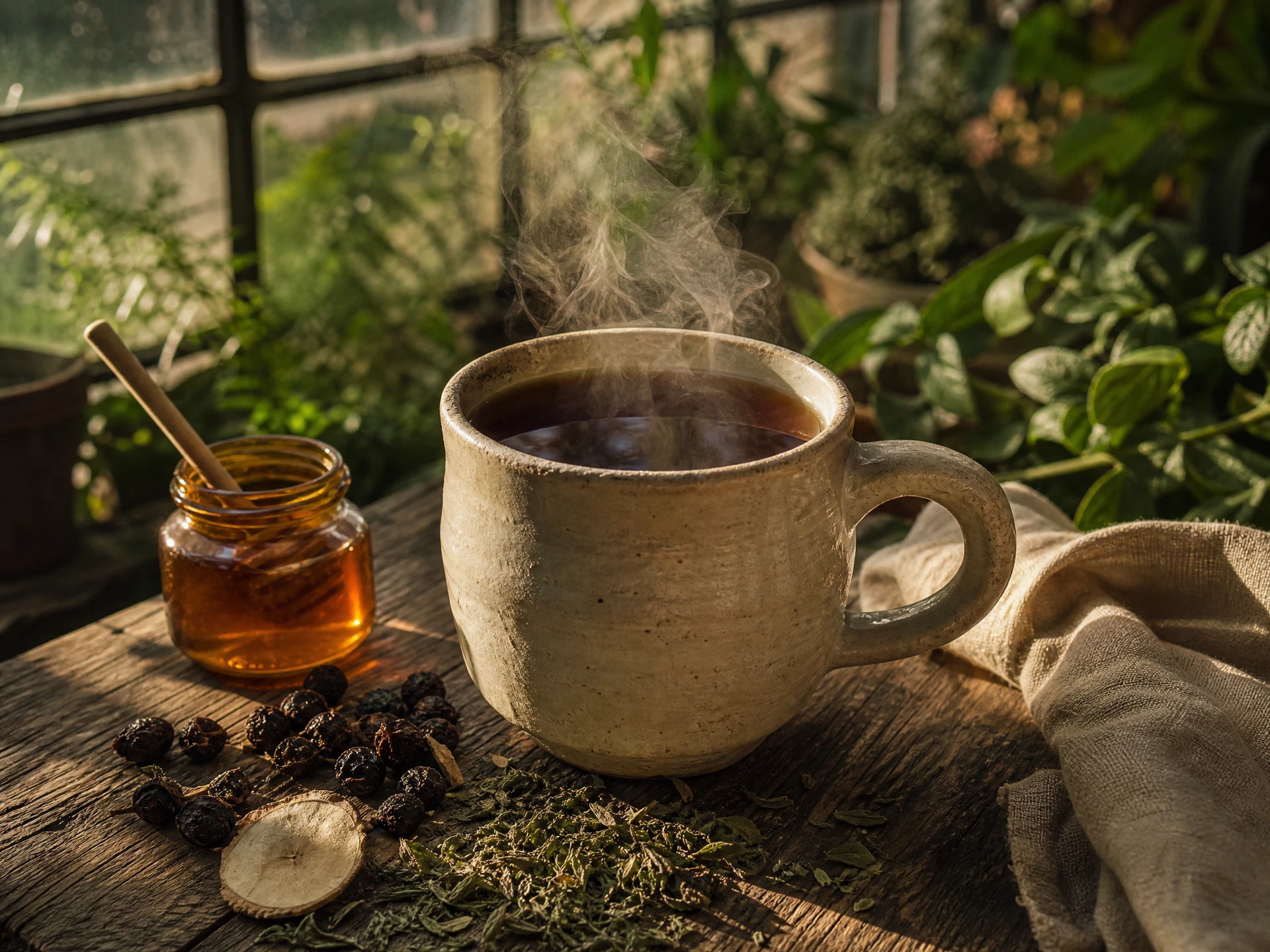
Because the medicine of the chaste tree resides in its dense, hard berries, a simple hot water infusion will not coax out its deeper properties. If you are working with the whole or lightly crushed dried berries, they require a decoction—a gentle, rolling simmer for at least twenty minutes to break down the tough exterior and release the plant's active constituents. Traditionally, herbalists recommend simmering one teaspoon of the crushed berries in a cup and a half of water until the liquid reduces to a single, potent cup.
However, because the decoction can be quite bitter and peppery, many women find that a tincture or a standardized capsule is a more sustainable way to invite vitex into their daily rhythm. A tincture—an alcohol or glycerin extract—captures the plant's essence beautifully and is easy to take. The traditional approach is to take vitex first thing in the morning, ideally on an empty stomach, just as the sun is rising and your pituitary gland is most receptive to its gentle nudging.
Consistency is the secret to working with the chaste tree. This is not an herb you take only when you feel symptoms arising; it is a daily tonic. You take it every single day of your cycle, from the day you bleed to the day you bleed again. If you are weaving it into a broader ritual, it pairs beautifully with the deeply nourishing qualities of red raspberry leaf or the warming, blood-building nature of dong quai. You might also find it as a cornerstone in our moon cycle tonic, designed to support the entire arc of your month.
When bringing vitex home, look for whole berries that are dark, fragrant, and unbroken, or choose tinctures and capsules from makers who prioritize organic, freshly dried material. Store your dried berries in a cool, dark cupboard, tightly sealed in glass, where they will keep their peppery vitality for up to a year. Remember, you are embarking on a slow journey with this plant. Give it three full months of quiet, daily devotion before you ask it to show you what it has done.
Who Should Be Careful
Pregnancy & Nursing
While vitex is traditionally used to prepare the body for conception, it should be discontinued once you become pregnant and avoided while nursing. Let your body's own profound wisdom take the lead during this season.
The chaste tree is a profound and powerful plant, and because it speaks directly to the master glands of your endocrine system, it demands deep respect. If you are currently taking hormonal contraceptives—whether the pill, the patch, the ring, or an implant—you must leave vitex on the shelf. It can alter your body's hormonal signaling enough to make your birth control less effective, and that is not a surprise anyone wants.
Similarly, if you are navigating the intense and carefully orchestrated world of fertility treatments or IVF protocols, vitex should not be used. Your medical team is already managing your hormonal cascade, and this herb will interfere with their work. Because vitex influences estrogen and progesterone, it is also contraindicated for women with hormone-sensitive conditions, such as certain breast cancers or uterine fibroids, unless you are working closely with a clinical herbalist or physician.
Vitex also has a unique effect on dopamine receptors in the brain. For this reason, it must be strictly avoided if you are taking dopamine-affecting medications, including certain antipsychotic drugs and medications used to manage Parkinson's disease. Finally, while it has a long history of use in preparing the body for conception, tradition and modern caution agree: once you are pregnant, and while you are nursing, it is time to stop taking vitex and let your body lead the way.
Please, always bring your chosen herbs into the light. Share what you are taking with your doctor, midwife, or clinical herbalist, so they can care for the whole of you.