nervine
Black Cohosh
Actaea racemosa
A tall, white-plumed woodland plant native to eastern North America, long valued in traditional practice for women's transitions. It is most often reached for to support the body through the hot flashes and night sweats of perimenopause.
Traditionally reached for
Where it comes from
Folklore & History
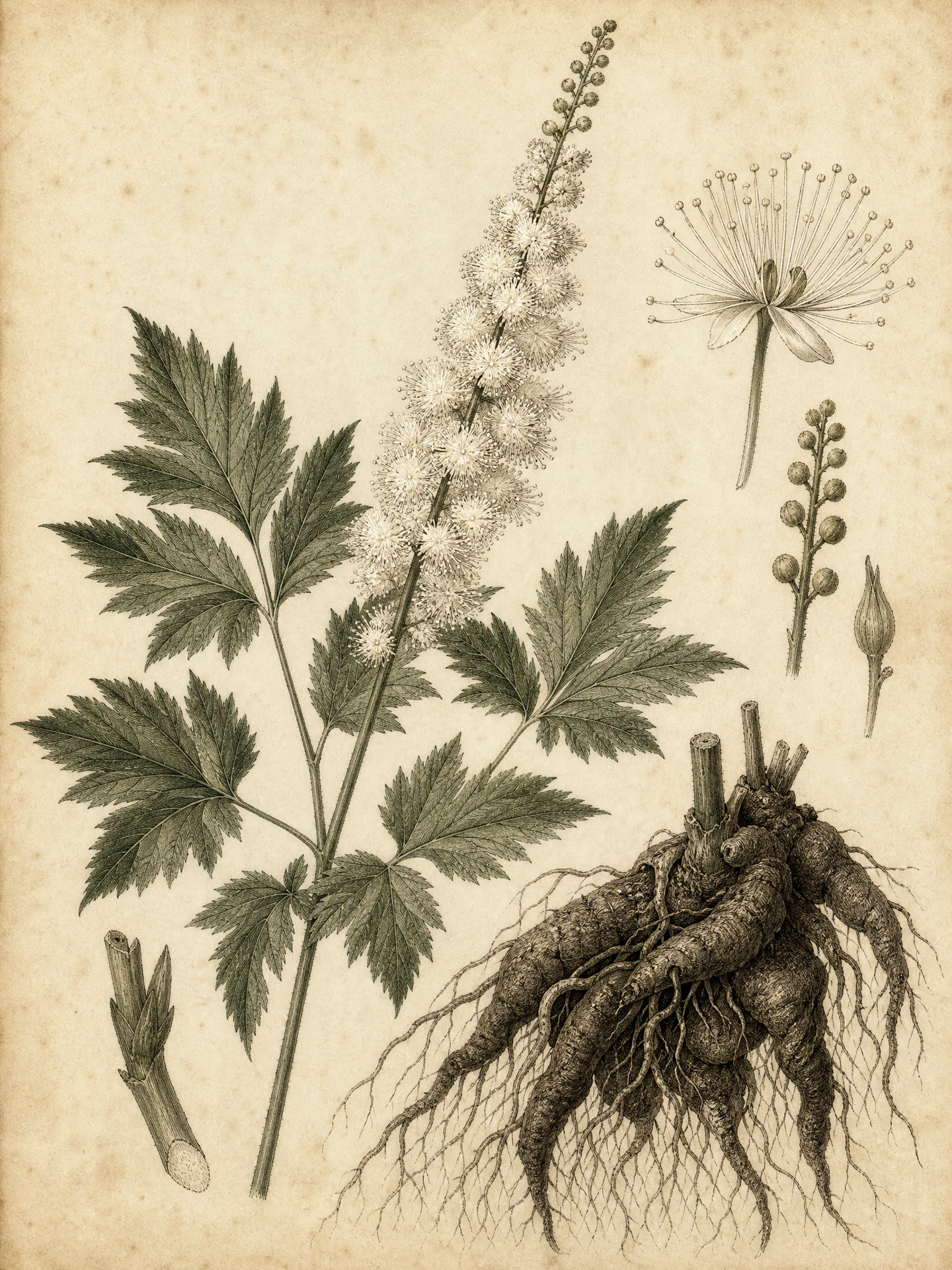
Deep in the shaded, damp woodlands of eastern North America grows a plant that commands attention. Black cohosh (Actaea racemosa) stands tall, sometimes reaching eight feet, crowned with striking, feathery white plumes that seem to catch the dappled forest light. Its leaves are broad and deeply divided, but it is the gnarled, dark root beneath the soil that holds the plant's true power. The root has a distinct, heavy scent—earthy, slightly bitter, and undeniably potent.
Long before it found its way into modern apothecaries, black cohosh was deeply known to the Indigenous peoples of its native range, including the Cherokee and Iroquois. They understood its affinity for the female body, reaching for it to support women through the profound transitions of their reproductive lives, as well as for its grounding, soothing qualities.
When European settlers arrived, they observed these practices and adopted the plant into their own folk medicine. They gave it names like "black snakeroot" and "rattleweed," nodding to the sound its dried seed pods make in the autumn wind. By the nineteenth century, black cohosh had made a remarkable journey from the forest floor to the shelves of early pharmacies, becoming a cornerstone ingredient in popular patent medicines marketed as a "women's tonic."
Today, it remains one of the most recognized herbs for women navigating the shifts of perimenopause. Yet, despite its fame, it retains the wild, untamed spirit of the woods where it first grew—a reminder that the earth has always offered us exactly what we need, provided we know where to look and how to listen.
In plain language
What It Actually Does
For decades, the story told about black cohosh was simple: it was thought to be a phytoestrogen, a plant that mimicked estrogen in the body, stepping in when our own levels began to wane. But the truth, as it often is with plants, is more complex and far more interesting. Modern understanding suggests that black cohosh is not a phytoestrogen in the way we once assumed. Instead, it seems to work its magic through the nervous system, acting as a nervine that helps the body find its footing when the ground feels unsteady.
In traditional practice, herbalists reach for black cohosh when a woman's internal thermostat has gone awry. It is most famous for its ability to soothe the sudden, overwhelming heat of hot flashes and the damp, disruptive wakefulness of night sweats. It is thought to communicate with the brain's temperature-regulating centers, helping to smooth out the erratic signals that come with hormone balance shifts.
However, honesty is our foundation here, and it is important to speak plainly: black cohosh is not a miracle cure, and it does not suit everyone. For some women, it brings profound relief; for others, it does very little. The evidence is genuinely uncertain, and the exact mechanisms remain a mystery that science is still trying to unravel. It is also a slow-acting herb; it requires patience and consistency, often taking several weeks to gently shift the body's rhythms. It pairs beautifully with passionflower for those nights when sleep feels entirely out of reach.
How to use it
Preparation
Black cohosh is a root, which means it requires a bit more coaxing to release its wisdom than a delicate leaf or flower. In traditional practice, it is most often prepared as a decoction—simmered gently in water rather than simply steeped—or taken as a tincture, which is often the most practical and reliable method for modern women.
If you are working with the dried root, you will want to simmer about a teaspoon in a cup of water for twenty to thirty minutes. Be forewarned: the taste is strong, earthy, and distinctly bitter. It is not a tea you drink for pleasure, but rather a tonic you take with purpose. Because of its intense flavor, many women prefer to take it as a tincture or in capsule form.
When seeking out black cohosh, quality is paramount. Look for sustainably wildcrafted or organically cultivated roots, as this plant has faced overharvesting in its native habitats. A good tincture should smell deep and earthy, a true reflection of the forest floor.
This is not an herb for quick fixes. It asks for your patience. You should expect to take it consistently for four to eight weeks before you begin to notice its grounding effects. It is often taken twice a day, morning and evening. We love it as part of our perimenopause peace tea ritual. Store your dried root or tincture in a cool, dark place, away from the heat of the sun, to preserve its potency.
Who Should Be Careful
Pregnancy & Nursing
This herb must be strictly avoided during pregnancy and nursing, except under the direct supervision of a qualified midwife at term.
This is an herb that demands respect, and it is not one to take casually or indefinitely. If you are pregnant, nursing, or have a history of hormone-sensitive cancers, this is not the plant for you—please involve your oncologist before considering it, especially if you are taking tamoxifen. Because there are rare but documented reports of liver injury associated with its use, it is conventionally used for a limited course of months rather than years. You should avoid it if you have liver conditions, take liver-affecting medications, or consume alcohol regularly. If you ever notice dark urine, jaundice, or upper right abdominal pain while taking it, stop immediately and seek care. As always, we encourage you to bring your own practitioner into the conversation when introducing a new herb to your routine.